What are customer feedback loops… and why are they important?
Simply put, a customer feedback loop is a process that informs your development team on customer desires to ultimately strengthen your product and increase stickiness.
A good process institutes your customers as product advisors, either formally where you’ll see things such as a Customer Advisory Board, or informally, with a series of responses to surveys, feature requests, or ad hoc feedback to their CSM.
If you’ve created a well-oiled Customer Success-R&D machine, your Product team is able to make decisions and build a better product based on this valuable insight.
Often times however, there’s at least one or possibly many important pieces of the process that are missing, leading to ‘voiceless’ paying customers.
The Stages of a Customer Feedback Loop
Collecting feedback
At a high-level, starting a customer feedback loop is dependent on opening channels for your customer to provide feedback. This could take the form of surveys, 1:1 checkpoints with a CSM, or a feedback/request portal.
Once the feedback has been received, the CSM should analyze the feedback first to understand if there’s any associated risk with the sentiment. If further discovery is required to understand the nature of the feedback, this should be completed ahead of meeting with R&D teams or CS leadership.
From here, a conversation should be held with the R&D team and any additional internal stakeholders to discuss and prioritize the feedback. If an action has been determined, the customer should be notified of any timelines and finally delighted once the issue has been finalized or resolved. Be cautioned that not every piece of customer feedback will be actionable or warrant a resolution.
Types of Customer Feedback Loops
Closed-loop feedback
A closed-loop feedback system involves actively responding to customers, letting them know how their feedback will be implemented, and taking action to address their concerns.
Surveys are one of the most effective tools for collecting feedback, but the key to success lies in follow-up. By using a closed-loop feedback system, you can identify and resolve issues before they escalate, improve the overall customer experience, and build trust in your customer.
Consider the following types of closed-loop feedback:
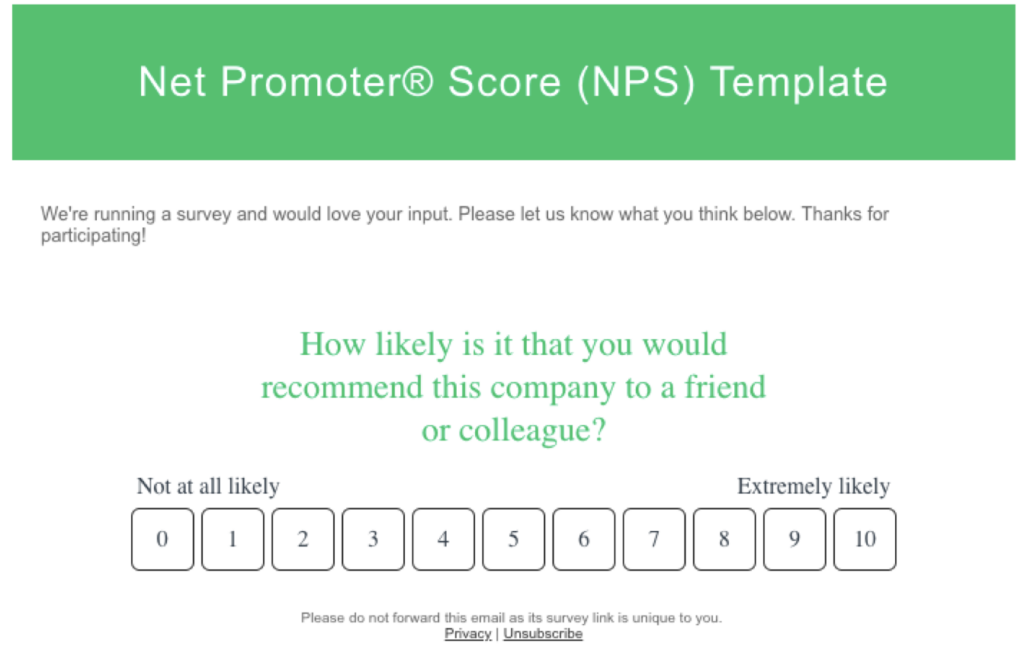
- Net Promotor Score (NPS) Surveys
- Survey based on a single question, asking your customers the likelihood they would recommend your business, product or service, generally on a scale of 1-10.
- Segments customers based on responses into Promoters (9-10), Passives (7-8) and Detractors (0-6).
- NPS = (% Promoters) / (% Detractors)
- Customer Satisfaction (CSAT) Surveys
- Single-question survey asking customers to score their overall satisfaction, generally on a 1-5 scale.
- This can be targeted after specific engagements or lifecycle milestones. For example, a CSAT survey after completing a support request, or upon exiting Onboarding.
- 2-Step Sentiment Surveys
- Most basic survey which leaves no room for indecision.
- Asks customers to rate either ‘thumbs-up’ or ‘thumbs-down’.
Each one of these surveys gives you an opportunity to ‘close the loop’ by following up with the customer. For example, a CSM could inquire about a Detractor score on an NPS survey to learn about the customer’s concerns and how to address them.
When customers see that their feedback is actually acted upon, it increases their satisfaction and loyalty. If you have a great closed-loop feedback process, you should witness NPS or CSAT scores improving over time.
Open-loop feedback
While not as direct of a process as closed-loop feedback, open-loop feedback can be incredibly valuable for your team when used in the right instance. Where this type of feedback differs from a closed-loop process is that a customer may not always be notified of how your company determines to act. This feedback is generally used to help steer your product or service as part of expert opinion by the end users. It can be less actionable at the individual customer level, but when your product team weighs any feedback against all other customer requests, go-to-market planning, and sales targets, it can paint a captivating picture.
You have a bit more room to be creative with open-loop feedback and may consider the following avenues:
- Product-Customer 1:1s
- Some customers may want to be compensated for their time. If your product team needs this type of input, consider baking a commitment into their contractual agreement, reflected by a small but meaningful discount to their subscription price.
- Customer Advisory Boards
- Select customers should be invited to a Customer Advisory Board (CAB), determined by their industry experience, familiarity with your business, and sentiment.
- CABs provide a platform to test new ideas, gather feedback on potential product developments, and ensure your business aligns with market trends and customer expectations.
- Market Research and Focus Groups
- Specific focus groups could be assembled of a smaller group of customers with a similar use case to determine a path forward on new functionality or verticals.
While we are responsible for ensuring customers are heard at our organizations, Product marketing and R&D should ultimately own Customer Advisory Boards (CABs), focus groups, and product-customer 1:1s. These teams are directly responsible for building a product that aligns with customer needs and by leading these initiatives, they can gather these insights, validate new ideas, and ensure that products are built with real customer feedback in mind.
Building Feedback Loops
Creating feedback channels
Develop channels as a way to receive feedback from your customers. If you’re operating high-volume Digital Touch portfolios, surveys, forums, or an online community may be your best way to tackle customer requests and feedback at scale. From here, you can choose when to escalate concerns up to a CSM or Product team, or address
At a more personal management level where you have an Enterprise team of CSMs, feedback should be included as part of ongoing conversations with stakeholders – including cadenced checkpoints, QBRs, or status reports.
Easy prioritization framework
When evaluating new feature requests, the below framework is an easy way to determine overall impact and prioritization. Note that we should almost always pursue opportunities that are “High” in Business Value, while rating “Low” in Complexity/Effort. These are often easier ‘internal-sales’ as well, as any added development takes away capacity from the R&D team.
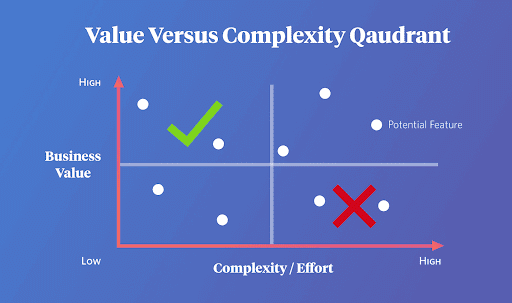
This doesn’t mean that every ‘High’ Effort feature is out of contention. Weigh the value against any potential churn/downsell/adoption risk for the requesting customer and consider any upsells or new opportunities that could have a similar product need. Work with your colleagues in sales to help determine this cross-directional impact.
Keeping the conversation going
If you determine that a request is not a priority, as your product, services, and customers continue to evolve it may justify a higher importance. Consider keeping a centralized document, spreadsheet, or logging any requests/feedback into your CRM. This should be shared with both R&D and Sales as well. A bi-weekly or monthly cadence is a good way to keep in touch on requests and update prioritization.
Common Pitfalls and How to Avoid Them
Bombarding your customers with requests
Retrofit your customer feedback requests into your customer processes and lifecycle milestones. Onboarding exits are a great time for a simple survey and obtain valuable feedback for both your Onboarding process, as well as that ‘first-look’ feedback by a new customer on your product or service. After finishing a major achievement assisted or completed by your team, this could be another time to check-in with your customer.
Support requests should almost always be followed up with a 1-click survey. This can be automated with your existing customer service/support platform (such as Zendesk). However, if you’re finding that your product lends to many support requests at this point in your company stage, consider tuning down any automated surveys to limit no more than every 3-4 requests, or 1-2 surveys a month.
Keep in mind how much time you are taking away from your customer with any requests. While surveys can be quick and easy, longer form feedback with either Customer Advisory Boards or open-loop feedback meetings with Product can be overwhelming and difficult to fit into a schedule. Generally, open-loop feedback meetings should be limited to no more than once or twice a quarter; CABs are generally quarterly or semi-annual.
Ignoring negative feedback
Negative feedback is actually the most useful; it gives your team an opportunity to grow, building a stronger product and better customer experience in the process. Addressing concerns head-on not only helps resolve issues quickly but also shows responsibility in a team to acknowledge and act upon critical feedback. Depending on the customer sentiment and risk, escalation within the CS team, Product, or executive leadership may be necessary.
